Customer
ProHawk Cleans the Data Other AI Never See
ProHawk AI turns Rugged laptops and tablets into field-ready AI that can see through fog, rain, and pitch-black darkness.
Key takeaways: Brent Willis, COO of ProHawk AI and a former Army combat arms officer, is commercializing pixel-by-pixel computer vision that cleans degraded video in real time, before any downstream model ever sees it. Using as few as 500 CUDA cores on an NVIDIA GPU, ProHawk earned Dell Validated Design status after 3.5 years of testing, validation and scaling and now runs on Dell Pro Rugged 14 equipped with the NVIDIA RTX discrete GPU for field teams in defense, border security, energy and maritime work.
Brent Willis spent his early career learning to spot threats before they arrived. A West Point graduate and U.S. Army officer, he quickly rose through the ranks in the military to become the Future Concepts Officer for Air Defense. Believing that the long-term wars would be economic ones, he left the military and ended up running global businesses, living in China for six years, then running Coca-Cola operations across North Latin America, before joining a small beer company in Belgium, changing its name to InBev, launching Stella Artois worldwide and becoming the world’s largest beer company.
Now, as COO of ProHawk AI, Willis continues solving the problem that has defined him since his military years: seeing what others don’t see and spotting opportunities and threats clearly when others see nothing at all.
The cost of fog, rain and darkness

The AI industry spends enormous energy on models, chips and infrastructure. But few ask what happens when the data feeding those systems is degraded before it ever reaches an AI application.
Sensors in the physical world actually capture images through fog, rain, snow, darkness, sea spray and pollution, but they’re not seen because of hardware limitations. This hampers many applications. Autonomous driving systems trained on clean data struggle in slightly inclement weather. The same is true for pipeline inspectors working in zero-light conditions where footage comes back functionally useless. Surveillance cameras in driving sleet can’t distinguish a human from a fence post.
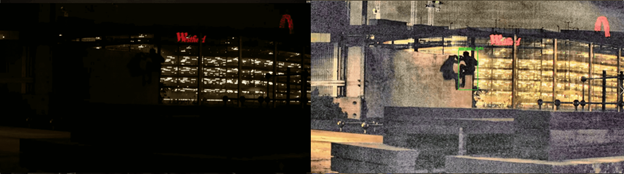
The problem isn’t the AI model; it’s the incoming signal. ProHawk’s software processes the incoming signal pixel-by-pixel in real time, stripping away environmental interference to produce actual intelligence. Willis describes the company as “Janitor AI,” because they clean up the incoming data and make it actionable and usable such that everything in the entire AI stack downstream works.
As few as 500 CUDA cores and a three-minute install
ProHawk uses as few as 500 CUDA cores on an NVIDIA GPU. For context, even entry-level NVIDIA cards carry several thousand CUDA cores. That minimal footprint means the software installs in roughly three minutes with no custom code, and latency runs at three milliseconds. To contrast, a blink of the human eye takes about 16.
Willis credits the hardware. “We wouldn’t be able to achieve any of the real-time benefits without the NVIDIA chip, but we can utilize virtually any NVIDIA chip. It doesn’t have to be a Blackwell or any of the latest high-demand chips.”
The software runs on GPUs for real-time processing or on CPUs for forensic post-analysis, where the speed requirement may be less critical. That flexibility matters in the field. A technician inspecting a ship hull may not need millisecond response time but does need clear imagery from a camera that captured almost nothing visible.
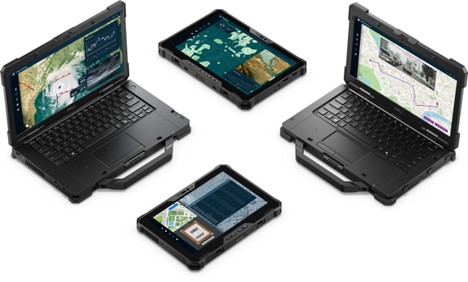
Due to ProHawk’s small compute footprint, it runs excellently on Dell Pro Rugged laptops and tablets: hardened devices rated for rain, dust, vibration and temperature extremes, that are also equipped with mid-range NVIDIA RTX GPUs.
“We are a perfect fit with a Jetson or a Nano to go on satellites, to go on UAVs, to be in a ruggedized laptop or the Dell Pro Max with GB10,” Willis said. “There are few technologies that are that compute-light, that actually work at the extreme edge.” Field workers in energy, maritime, telecom or defense who already carry Dell Pro Rugged devices can run ProHawk AI on the hardware they have.
Three and a half years of testing
ProHawk AI is one of less than ten ISVs to earn Dell Validated Design status and is now part of the Dell AI Factory with NVIDIA. To earn the coveted status, Dell evaluated all computer vision technologies across the market before choosing ProHawk, then moved into lab testing to scale ProHawk across Dell’s full hardware lineup and every NVIDIA chip configuration. The process resulted in a 37-page white paper documenting integration across Dell and NVIDIA stacks, from ruggedized laptops to data center servers.
ProHawk now ships preloaded on Dell hardware sold through resellers like WWT, SHI, CDW and others. For customers in defense, border security and energy infrastructure, the preloaded configuration solves a problem beyond convenience. ProHawk’s footage often involves classified or sensitive data that cannot leave the device. Sending video to the cloud for processing introduces unacceptable latency, bandwidth costs and security exposure. Running inference and storage locally on a Dell Pro Rugged device keeps data under the operator’s physical control from capture to analysis. Removable SSDs in Dell Pro Rugged laptops and tablets protect data during service and end-of-life events, as well. Dell Pro Rugged devices protect data throughout their complete lifecycle.
From R&D to revenue
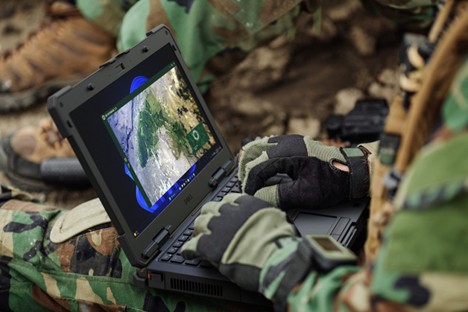
ProHawk spent years in research as proof-of-concept work with Boeing, SpaceX, the Department of Homeland Security and the Secret Service before beginning commercial operations in the past 12 months. Today, use cases range from military border protection to retail loss prevention at self-checkout stations, manufacturing defect analysis and maritime harbor management.
Performance testing documented in the Dell Validated Design white paper found that ProHawk enables users to see 20 times farther and process imagery 80 times faster than unenhanced feeds. As such, ProHawk AI can identify threats faster in the most complicated operating environments, so that organizations can make faster and better-informed decisions based on actual intelligence.
For teams carrying Dell Pro Rugged devices into conditions where visibility is the first thing to fail, Willis still frames the work the way he framed air defense decades ago. “Know what’s out there, detect it, classify it and then reach out before it reaches you.”