Cyber Resilience
Why Modern Ransomware Demands a Layered Cybersecurity Strategy
How Dell Cyber Detect strengthens the cyber-resilience advantage of PowerStore and PowerMax.
Key takeaways 5 min read
-
- The threat has changed: AI-accelerated ransomware enables attackers to move faster, evade detection and compromise recovery points — making rapid detection and response — just as critical as recovery.
- Protection starts in the platform: PowerStore and PowerMax have security built in — immutable snapshots, strong access controls, hardware root of trust and encryption.
- Detection reaches critical data: Dell Cyber Detect adds content-aware analysis — 200+ analytics, 7,500+ ransomware variants, 99.99% accuracy — plus faster clean-recovery-point identification.
- Dell’s portfolio is the differentiator: PowerProtect, Data Domain and AIOps tie protection, detection and recovery into one strategy — while competitors sell only pieces.
Ransomeware attacks are growing in scale, speed and complexity, making them increasingly difficult for organizations to contain and recover from. It has become an industrialized business, with attackers routinely encrypting and stealing data to maximize leverage over victims. At the same time, AI-powered tools are accelerating the path from vulnerability discovery to exploitation, helping attackers move faster and operate at greater scale. They often target multiple recovery points before an attack is discovered. The challenge is no longer simply restoring data — it is reducing exposure, detecting corruption early and rapidly recovering with confidence. Traditional approaches often treat protection, detection and recovery as separate problems. This is where Dell raises the bar. Dell brings these capabilities together through a broad portfolio of cyber resilience solutions designed to help organizations protect, detect and recover from attacks. Working in concert, these capabilities help safeguard business-critical data before, during and after an attack — and strengthen the cyber-resilience advantage of PowerStore and PowerMax.
Security built in, not bolted on
Any credible ransomware strategy starts with the storage platform itself. Both PowerStore and PowerMax provide a strong cybersecurity foundation with built-in capabilities designed to reduce risk and protect data, including:
-
- Hardware root of trust, digitally signed firmware updates and data at rest encryption designed to support governance and regulatory requirements.
- Secure, immutable snapshot technologies that help protect data from unauthorized change or deletion.
- Robust access controls, such as multi-factor authentication and multiparty authorization,² to limit exposure from compromised credentials or admin error.
For customers, those capabilities matter because they help reduce opportunities for unauthorized change, lower the risk of compromised credentials or administrative error, support governance and compliance requirements and preserve more trustworthy recovery points when an incident occurs. That is an important differentiator. Dell is not asking customers to bolt cyber resilience onto an otherwise generic storage platform. It starts with infrastructure that is already designed to strengthen security and operational resilience at the core.
Detection that reaches your most critical data
Dell Cyber Detect extends content-aware detection and recovery guidance beyond traditional backup workflows, helping customers spot signs of corruption closer to the data that matters most.
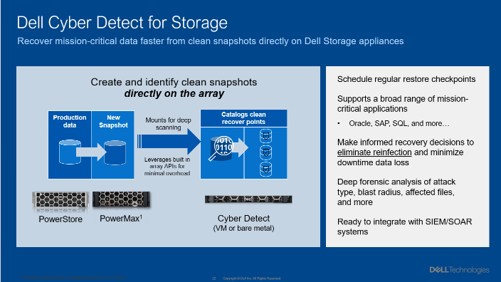
For PowerStore and PowerMax environments, it delivers:
-
- Deeper inspection of snapshot-associated data using more than 200 content-aware analytics — not just metadata signals like change rates or file extensions.
- Detection informed by training on more than 7,500 ransomware variants, catching encryption, corruption and subtle manipulation earlier in the attack chain.
- It detects ransomware-related data corruption with 99.99% accuracy,¹ giving teams confidence in the signals behind their recovery decisions.
- Faster identification of clean recovery points, so teams know what to restore and from where.
- Support for security workflows through capabilities such as YARA rules, plus richer forensic insight into what changed and where.
Together, these capabilities help response and recovery move faster, with less guesswork when every minute counts.
Where other approaches fall short
Many competitors still force customers into a compromise. Some run detection only after data has moved to backup or secondary infrastructure — by which point corrupted data may already exist across multiple sites and recovery points. Others lean on lightweight anomaly checks based mainly on metadata signals like change rates or file extensions, which can miss deeper corruption, targeted manipulation and low-and-slow encryption designed to evade detection.
And many vendors still sell only pieces of the problem: storage without meaningful detection, backup without strong integration, or analytics without a broader recovery architecture. Dell’s advantage is that it connects these layers into a cohesive strategy.
1 Based on an ESG report commissioned by Index Engines, “Index Engines’ CyberSense Validated 99.99% Effective in Detecting Ransomware Corruption”. June 2024. Actual results may vary.
2 This feature is available only on PowerStore systems with OS version 4.3 or higher.