PowerStore
Why Dell Technologies is Ranked #1 in Enterprise Storage
Dell is No. 1 in enterprise storage worldwide. But share is the result, not the story. Here is what is actually driving the growth.
Key takeaways 4 min read
Dell built its storage portfolio around the three priorities customers said mattered most: private cloud they control, an AI engine that runs on their own data and cyber resilience that protects all of it. That integrated approach is why customers keep expanding with Dell and how it closed Q1 2026 as the world’s No. 1 external enterprise storage vendor.
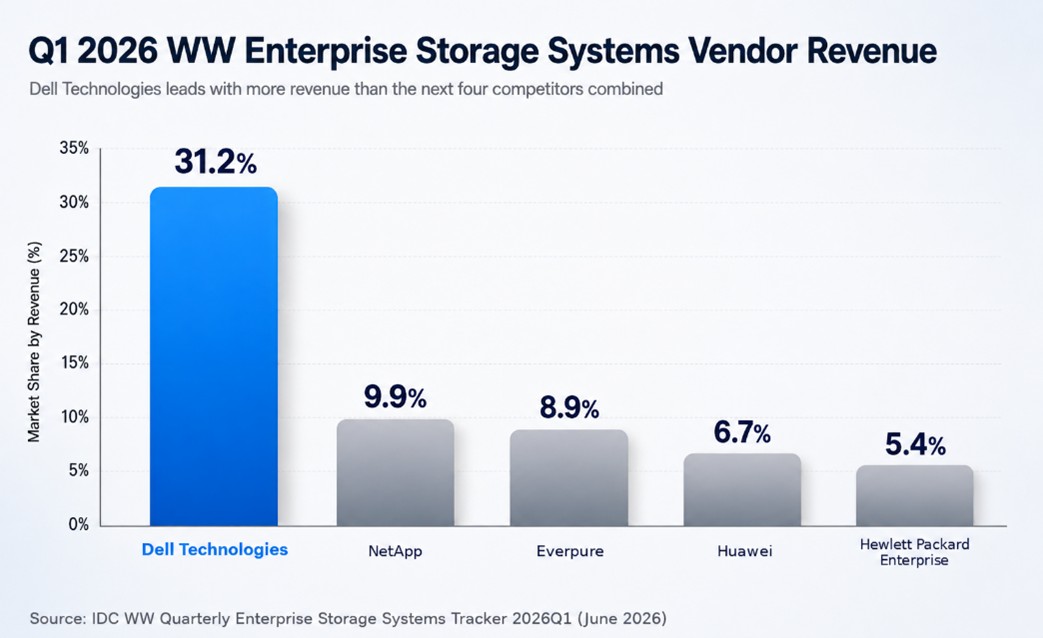
Dell finished the first quarter of 2026 as the No. 1 external enterprise storage vendor in the world, with 31.2 percent share and 40.8 percent year-over-year growth, according to IDC’s Worldwide Quarterly Enterprise Storage Systems Tracker.¹ We grew at nearly twice the pace of a segment that itself grew 22.7 percent.
Here is the line that frames the quarter. In 1Q26 you could add up every other vendor on IDC’s top five list and the combined total still would not outsell Dell. It is what happens when you keep shipping.
Share is the result, not the story. The story is the pace. We do not innovate in a vacuum. Customers tell us where their toughest challenges are and we build the answer. Right now, that comes down to three things they keep asking for: a private cloud they control, an AI foundation that runs on data they own and cyber resilience that protects their infrastructure. We built the portfolio around those priorities because customers told us they mattered.
Private cloud on the customer’s terms
Enterprises are done choosing between flexibility and simplicity. They want both, and they do not want to be locked into a single stack to get them.
Dell Private Cloud, delivered through the Dell Automation Platform, lets organizations run their cloud software of choice from Broadcom, Microsoft, Nutanix and Red Hat on open, disaggregated Dell infrastructure. At Dell Technologies World, we extended that choice with support for VMware Cloud Foundation 9.1, Microsoft Azure Local and PowerStore integration with Nutanix AHV. Compute and storage scale independently, lifecycle management is automated and the model delivers up to 65 percent cost savings versus traditional HCI.² That last number is the one customers keep coming back to.
That only works if the storage underneath keeps up. PowerStore Elite is built to be that foundation. One platform serves block, file, virtual machine and container workloads, so a single system supports whatever hypervisor sits on top. It brings up to three times the performance of prior generations³, an industry-best 6:1 data reduction guarantee⁴ and non-disruptive upgrades. Existing customers fold it in through mixed-generation clustering and keep themselves continuously modern.
AI that runs on data customers own
AI is only as good as the data it can find, trust and act on, and most of that data sits inside the enterprise. The customers winning with AI are the ones who can put their own data to work without shipping it to someone else’s cloud.
That is what the Dell AI Data Platform, part of the Dell AI Factory, delivers. New orchestration and search capabilities index billions of unstructured files and connect them into governed pipelines, speeding up data discovery and dataset creation so customers move from pilots to production faster. Data analytics capabilities bring GPU-accelerated SQL analytics to that data and return queries up to six times faster on NVIDIA Blackwell GPUs.⁵
Storage carries the weight underneath. PowerScale and ObjectScale turn scattered, siloed data into an AI-ready dataset, and the new ObjectScale X7700 ultra-dense appliance delivers up to 45 percent more HDD capacity than the prior generation⁶ with improved TCO. Forthcoming 245 TB all-flash drive support will more than triple ObjectScale flash density.⁷
Cyber resilience inside the platform
Every AI and private cloud conversation now ends in the same place: how do we protect this when it gets attacked? Customers are not asking whether they will be targeted. They are asking how fast they can recover.
Dell PowerProtect One answers that by unifying protection orchestration and protection storage under a single control plane, cutting management overhead by up to 50 percent⁸ while preserving the data reduction and large-scale recovery customers already depend on. Dell Cyber Detect brings AI-driven ransomware detection directly into PowerStore and PowerMax, flagging threats with 99.99 percent confidence⁹ so recovery starts the moment something looks wrong, not days later.
One foundation, one reason customers stay
Private cloud, AI and cyber resilience are not three separate pitches. They are one foundation. Customers get a private cloud they control, an AI engine that runs on their own data and resilience that protects all of it, all on infrastructure from a single partner.
That is why the No. 1 position is more than a ranking and why outselling the rest of the top five is more than a stat. Forty percent growth happens when customers expand with you instead of switching, and they expand when the foundation does everything they need it to. So we keep listening. To our customers: thank you. You set the pace.
1IDC WW Quarterly Enterprise Storage Systems Tracker, 2026 Q1 historical release, June 11, 2026.
2Based on internal Dell testing comparing the three-year cost of a five-node HCI cluster (92 TB storage, 163 TB capacity) to Dell Private Cloud with BYOS. Results assume data compression, DDR ratios, VMware RAID 5 erasure coding, and 1.5x compression. Actual results may vary. March 2026.
3Based on internal analysis comparing PowerStore 1500 and 1200T models using peak IOPs running 70/30 read/write mix, 8k block size over FC. Actual results will vary.
4Based on Dell analysis comparing primary storage data reduction guarantees vs Dell’s Storage Data Reduction program – May 2026. For PowerStore Gen 3, applies to new arrays initially installed with PowerStoreOS 5.0. For details see: All-Flash Data Reduction Guarantee Terms and Conditions. Actual data reduction rates will vary.
5Based on Dell internal analysis, May 2026.
6Based on Dell comparison of maximum available storage capacity on planned ObjectScale X7700 versus previous-generation ECS 5000, May 2026. Actual results may vary.
7Support for 245 TB drives and an expanded drive count per node are targeted for an ObjectScale release in 2H 2026. Actual usable capacity and density may vary.
8Based on Dell internal analysis, October 2025.
9Based on an Omdia/ESG report commissioned by Index Engines, “Index Engines’ Cyber Detect Validated 99.99% Effective in Detecting Ransomware Corruption”. June 2024. Actual results may vary.