Cyber Recovery
Why a Cyber Resilience Control Plane Redefines Infrastructure Defense
Fragmented signals leave teams flying blind. A cyber resilience control plane unifies signal intelligence across the storage and data layer and triggers coordinated action to contain threats.
Key takeaways: Dell’s research found that 63% of practitioners believe leadership overestimates their organization’s cyber readiness — a confidence gap driven by signals that exist but never connect. A cyber resilience control plane changes that by correlating intelligence across the storage and data layer and triggering coordinated defensive action before threats escalate.
The tools are deployed. The telemetry is flowing. The dashboards are full. And yet when an attack develops, most organizations still don’t see it coming in time to act. Dell’s Global Cyber Resilience Insights research found that 63% of practitioners believe leadership overestimates their organization’s readiness for a major cyber event. That’s the confidence-capability gap — the disparity between perceived cyber readiness and actual recovery capability — and it points directly at a problem hiding inside the infrastructure itself: signals that exist but don’t connect and threats that develop in the space between them.
The gap lives in many places. But it is most acute — and most immediately addressable — at the storage and data layer, where the earliest indicators of an attack surface and where signals are closest to the data that actually matters. It’s also where the solution begins. We’ll be specific about what’s real today versus what’s still being built — because the industry has done enough damage with vision decks that couldn’t survive a follow-up question.
You might reasonably ask: isn’t this what a SIEM is for? The short answer is yes — and no. SIEMs are built to ingest events from across the enterprise and surface patterns that warrant investigation. But they can only work with what they’re given. When primary storage, backup and recovery and object storage platforms each send isolated, low-context alerts, the SIEM receives three ambiguous signals with no shared baseline, no time-series relationship and no storage-layer context to make sense of them. The SIEM can’t correlate what it doesn’t understand. A cyber resilience control plane normalizes and correlates those signals at the storage layer — where the context actually lives — before they reach the SIEM. What the SOC receives isn’t three alerts to be sorted. It’s a pattern assessment with confidence already established.
The problem isn’t detection. It’s confidence
Security teams don’t lack detection capability. Most enterprise environments are already generating a significant volume of security-relevant signals — entropy shifts on protected data, I/O pattern anomalies on primary storage, audit events tracking access and modification behavior. The raw instrumentation exists. What’s missing is the ability to act on those signals early and with confidence, and that’s a different problem entirely.
Consider what actually happens during a developing ransomware event. Three things are occurring simultaneously across the storage environment — each one individually ambiguous, none of them aware of the others:
-
- A primary storage platform flags an unusual I/O pattern — repetitive read-write sequences on the same disk sectors, behavior that doesn’t match the workload’s normal profile.
- A backup and recovery platform detects a significant entropy shift — the statistical fingerprint of the data has changed dramatically since the last copy.
- An object storage platform surfaces a sudden spike in enumeration requests across buckets the application doesn’t normally touch — behavior consistent with an attacker mapping the data landscape before encrypting it.
Each signal falls below any reasonable action threshold on its own. Sent to a SIEM as three isolated events, they stay below that threshold. Corroborated across time and systems by the control plane, they cross it. The organization gains hours of response time it didn’t have before.
The honest starting point
Every IT organization is aiming for end-to-end cyber resilience. That ambition is justified — but it’s also where many strategies lose clarity.
It’s worth being explicit about scope, because this space has a credibility problem rooted in imprecision. Vendors — and we include ourselves in this critique — have sometimes framed cyber resilience as if strengthening the storage and data layer closes the loop on enterprise-wide risk. It doesn’t. What is addressable today is the fragmentation within the storage and data layer. That’s not a narrow starting point — it’s a pragmatic one. This is where data is created, where compromise first reveals itself and where recovery ultimately succeeds or fails. Starting here isn’t a constraint. It’s how progress becomes tangible — and how confidence is earned.
Correlated intelligence, coordinated response
At the center of this blog series is a coordination layer that makes existing capabilities function as an integrated system instead of isolated tools. That coordination layer is a cyber resilience control plane.
Dell is investing in bringing meaningful signal intelligence across the storage and data layer — drawing on behavioral indicators, data change characteristics and access patterns generated across primary storage and data protection workflows. These signals have historically been interpreted within the boundaries of individual systems. That’s precisely what a cyber resilience control plane is designed to solve: every signal source across the storage ecosystem, normalized and correlated so that a condition detected on one system immediately informs the posture of every other.
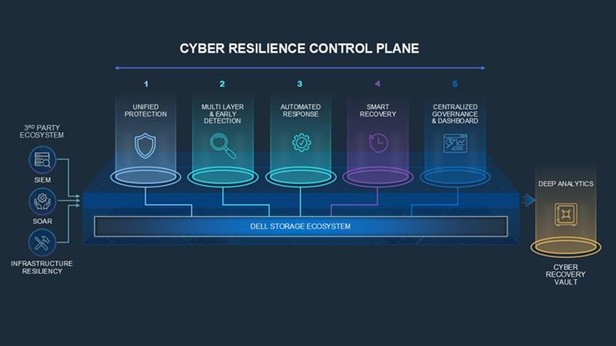
But correlation alone isn’t the destination. What makes this vision genuinely different is what happens next: when the control plane detects a developing threat, it doesn’t just raise an alert — it acts. Snapshots are triggered automatically on primary storage. Access is constrained. And critically, recovery points on the backup and recovery platform are locked simultaneously — ensuring that a clean, validated copy is preserved at exactly the moment it’s most at risk. That coordinated action across both the production and protection layers is what separates this from what a single-platform vendor can do. Detection and response become a single, continuous motion rather than two separate workflows separated by human latency.
As risk emerges, those actions scale proportionally — tightening access, protecting known-good data and positioning the environment for rapid containment and recovery. The control plane isn’t waiting to be invoked after the fact. It’s a participant in the security posture, continuously interpreting and adapting in real time.
The storage ecosystem is where this begins. As the control plane matures, it’s designed to integrate with the broader security ecosystem — working alongside the SIEM, SOAR and SOC tools organizations already depend on, feeding them correlated, contextualized signal rather than raw event noise. The storage layer stops being a passive system waiting to be queried after an incident and starts functioning as a first responder.
The gap between detecting a threat and acting on it is where most organizations lose. Closing that gap — at the storage and data layer and across the ecosystem it connects to — is what the next two blogs are about.
Read the next blog in this series here.