

PowerStore
When 2x on Paper Is Not Enough – Dell PowerStore
Why a leading competitor’s all-NVMe story breaks down when you measure throughput, latency and efficiency together.
Key takeaways: Headline performance claims only matter if they hold up under mixed, sustained workloads. In third-party testing, Dell PowerStore 9500 delivered stronger throughput, lower latency and better efficiency than a leading competitor – advantages that translate into more consolidation headroom, lower infrastructure cost and fewer compromises for your team.
Most all-NVMe arrays look competitive in a product brief. For IT decision-makers, that is not the real test. What matters is whether the platform can sustain performance, protect application responsiveness, and use capacity efficiently when transactional databases, analytics jobs and virtual machines all compete for the same infrastructure.
That is where vendor-friendly benchmarking can break down. In a recent Principled Technologies (PT) report, PowerStore 9500 was tested against Vendor A using mixed Vdbench workloads designed to reflect real storage demand, not just a narrow best-case scenario. The result was not a small separation at the margins. PowerStore 9500 delivered up to 2.33x higher throughput, up to 63.94% lower latency at matched target IOPS and up to 2.39x better storage efficiency.1
That contrast matters because the real decision is not which platform looks competitive on a slide. It is which one gives you more room to consolidate, more confidence under load, and fewer forced trade-offs as demand grows.
More throughput, fewer trade-offs
Vendor A’s headline numbers can look strong in isolation. The question is what happens when you need one platform to carry more than one kind of job at the same time.
In the report, PowerStore 9500 delivered up to 2.33x higher throughput than Vendor A.1 That kind of headroom does more than win a chart. It gives you room to consolidate more workloads onto fewer systems without forcing the usual compromise between performance and utilization.
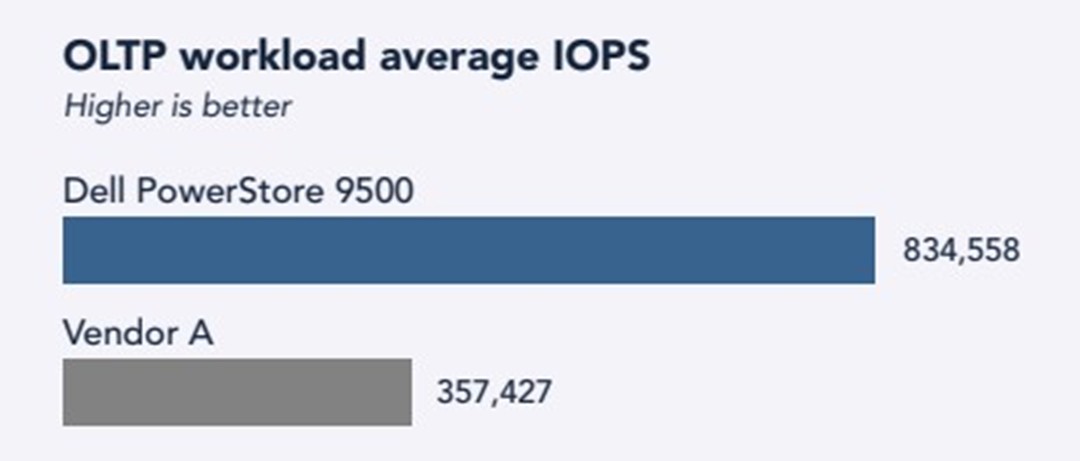
For your team, that changes the planning conversation. More usable throughput means fewer islands of infrastructure, fewer performance-driven workarounds, and more confidence that a refresh will support growth instead of creating another bottleneck a year later.
Lower latency where it counts
Measured at matched target IOPS, PowerStore 9500 delivered up to 63.94% lower latency than Vendor A in testing.1 That matters because users and applications do not experience a benchmark headline. They experience response time. Lower latency under comparable load is what helps protect database responsiveness, VM performance and service levels when contention rises.
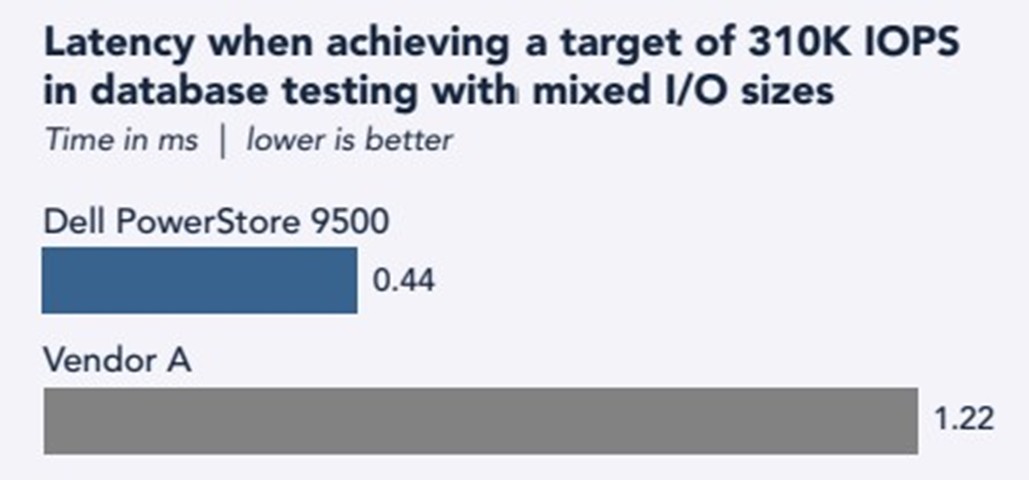
This is the practical difference between looking competitive on paper and performing reliably in production. For ITDMs, lower latency is not just a technical win. It reduces operational friction, protects user experience and helps avoid the hidden cost of overbuilding around performance uncertainty.
Efficiency should reduce cost, not just capacity
Efficiency claims deserve the same scrutiny as performance claims. If a vendor promises strong data reduction or dense capacity but cannot translate that into real savings, you still pay for the gap in drives, rack space, power and lifecycle cost.
PowerStore 9500 delivered up to 2.39x better storage efficiency than Vendor A.1 In the same testing, PowerStore achieved a 6.6:1 data reduction ratio, versus 2.76:1 for Vendor A. Dell also backs PowerStore with an industry-leading 6:1 data reduction guarantee on applicable workloads.2 That matters because efficiency is not just a feature. It is a budget and footprint decision.
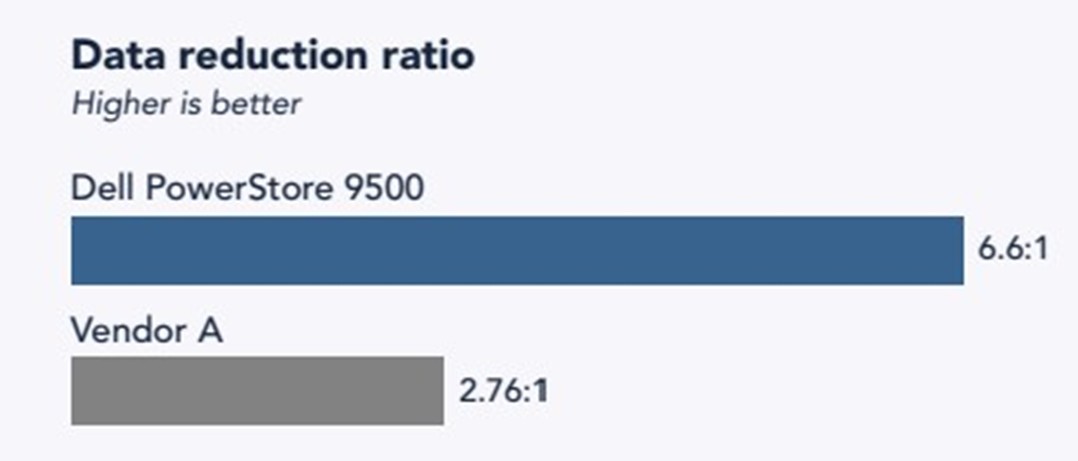
The platform’s dense design strengthens that advantage. In the report, PowerStore 9500 also provided up to 11% more drives per rack unit than Vendor A’s – 40 drives in 3 RU versus 48 drives in 4 RU – enabling up to 5.8 PBe of effective capacity in a compact footprint.1 For you, that means storing more data on fewer drives, reducing rack consumption, lowering energy demand and stretching the value of the refresh over a longer lifecycle.
Four questions worth bringing into your next evaluation
If a competitor claims parity, test that claim in the places where trade-offs usually surface:
- What workload mix was used to produce the headline benchmark?
- At matched target IOPS, what latency did the system sustain?
- What data reduction ratio was actually measured and is it backed by a guarantee?
- How much effective capacity, drive density and rack efficiency can the system deliver in practice?
These questions help shift the conversation from marketing posture to operational reality. They also make it easier to compare architectures based on what will affect your environment after the purchase, not just what looks strongest in a slide deck.
The better standard for comparison
The risk in taking a parity claim at face value is simple: you can carry unnecessary latency, avoidable capacity cost and added operational drag into your next refresh cycle.
A better outcome is possible. With stronger real-world throughput, lower latency at comparable load and materially better efficiency, PowerStore 9500 gives you a more durable platform for consolidation and growth. Before accepting any “close enough” story, run the four questions above through your next RFP or PoC alongside the full third-party results.
1 Based on Principled Technologies Report, commissioned by Dell, May 2026, comparing Dell PowerStore 9500 to a current-generation all-NVMe array from Vendor A running the same dataset, using Vdbench. Actual results may vary. Full report here.
2 Based on Dell analysis comparing primary storage data reduction guarantees vs Dell’s Storage Data Reduction program – May 2026. 6:1 applies to PowerStore Gen 3 only. See terms and conditions for details here. Actual data reduction rates will vary.