Partners
From Kitchen Table Curiosity to Educational Impact: Why This Robotics Pairing Matters
A small, build‑it‑yourself robot and powerful local AI team up to show how accessible, hands‑on innovation can spark the next generation of creators.
Key takeaways: Dell Technologies, Pollen Robotics, Hugging Face, and NVIDIA are teaming up to make hands‑on robotics and local AI accessible to students, educators, and hobbyists. Reachy Mini, an affordable, open‑source robot kit, pairs with Dell’s Pro Max with GB10 to run advanced language, vision, and speech models entirely on‑device for privacy and speed. A thriving Hugging Face community already offers 100+ apps that help learners experiment, remix, and build confidence in STEM and STEAM skills. Together, this ecosystem lowers barriers to robotics and empowers a new generation of builders to imagine, create, and innovate.
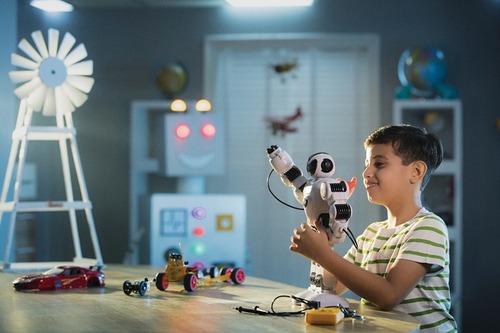
I’ll never forget the Saturday morning when my kids spread LEGO™ bricks across our kitchen table and asked me, “Can we build a robot that learns?” As a product technology leader and a parent who believes deeply in Science, Technology, Engineering and Mathematics (STEM), there’s nothing more energizing than that spark of curiosity. For years, the honest answer to their question would have been: not without a lab, a budget and a lot of luck. Today, that answer has changed.
What once required a university research grant now fits on a desk and in a family’s weekend project. That’s the breakthrough behind the Dell Technologies collaboration with Pollen Robotics, Hugging Face, and NVIDIA. Together, we’re bringing robotics and AI out of the ivory tower and into the hands of builders of all ages—safely, affordably and locally.
The big barrier that needed breaking
For decades, robotics has been a field where you read the papers but rarely touched the hardware. Access was a privilege filled with limited parts, specialized labs and proprietary stacks. Brilliant ideas stalled in journals because too few people could put them into practice.
Pollen Robotics set out to change that. Founded in 2016 by two PhD engineers, Matthieu Lapeyre and Pierre Rouanet, the team asked a simple question: What if we make robotics truly open and hands-on? Their early work earned global recognition—reaching the podium at the ANA Avatar XPRIZE in 2022, and then they did something braver: they created robots you could build at home.
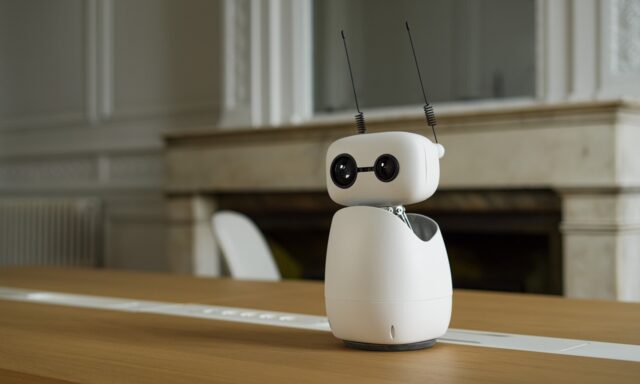
Enter Reachy Mini, a compact, expressive, open-source desktop robot that ships as a build-it-yourself kit for roughly $300–$450 and assembles in two to three hours. It’s programmable in Python, and more than 6,000 units are already on desks in classrooms, labs and homes across the world. The bet behind Reachy Mini is beautiful in its simplicity: If you build it, you can understand it. And if you can understand it, you can improve it.
Community is the new lab
If robotics is the body, community is the heartbeat. That’s why Pollen integrated Reachy Mini with Hugging Face Spaces, turning the robot into an open ecosystem where anyone can publish, remix and run apps with a click. The result? A flourishing library of 100+ community-built apps: language tutors, homework helpers, screen-time coaches, hand trackers and more. This is how young builders become mission-driven builders—by trying, sharing and learning in the open.
For educators, that matters. A seventh grader doesn’t need to reinvent the wheel to feel the joy of motion control, computer vision, or conversational AI. They can tinker with a working app, peek under the hood, and then make it their own. That’s how you grow confidence and eventually, future careers.
What happens when you add serious compute
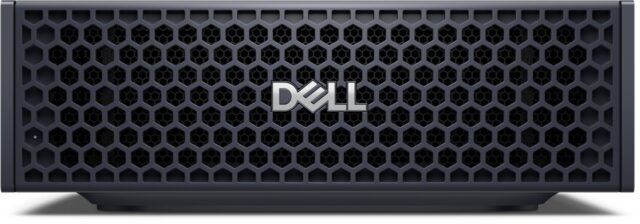
Now imagine you give that same robot a serious brain. That’s where Dell Technologies and NVIDIA come in. The Dell Pro Max with GB10, built on the NVIDIA Grace Blackwell Superchip architecture, turns Reachy Mini into a fully local AI agent—no cloud required. With NVIDIA DGX OS and a complete AI software stack, developers can run large language models, vision and speech on-device, privately and fast.
Why does local matter? Because privacy isn’t a feature, it’s a foundation. When your models run next to your robot, your data stays yours. For educators and researchers working with sensitive content, or parents like me who want their kids to experiment without relying on cloud uploads, local computing eliminates a significant barrier to adoption.
We’ve seen this principle in action on some big stages. At CES 2026, NVIDIA’s Jensen Huang showcased Reachy Mini paired with NVIDIA DGX Spark, built on the same Dell Technologies GB10 architecture as the Dell Pro Max. The demo wasn’t just impressive, it was a proof point for what’s now broadly possible: reasoning, vision and speech all running privately on your desk.
From passion to pathways
As head of product for Dell workstations, I find it thrilling to see a new generation approach robotics with the same curiosity, fearlessness and willingness to break and improve things that my peers once brought to PCs. Open-source hardware and software invite tinkering. Community invites momentum. Local AI invites trust. As a parent, I see pathways. A child who builds a $300 robot today may decide to pursue mechatronics, human-computer interaction or responsible AI tomorrow. STEM becomes Science, Technology, Engineering Art and Mathematics (STEAM), when creativity sits alongside code—when a robot doesn’t just “work,” it delights. That joy is the on-ramp to deep learning and lasting purpose.
This isn’t just a product story; it’s a generational one
We’re not just enabling robots to see, speak and reason. We’re enabling young people to imagine, build and lead. When barriers fall—price, access and complexity—potential rises. That’s the real promise of this collaboration: Pollen Robotics, Hugging Face, NVIDIA, and Dell Technologies aligning to shape a new generation of mission-driven builders.
One day soon—maybe sooner than we think—kids won’t ask whether they can build a learning robot. They’ll ask what they want it to learn next. And we’ll be right there with them.
See it live—and start building
You can experience this collaboration in person at GTC 2026, March 16–19, in San Jose—stop by the Dell booth to see Reachy Mini running as a fully local AI assistant on the Dell Pro Max with GB10.
How to get started right now:
-
- Reachy Mini is available through Pollen Robotics as a build-it-yourself kit. For a limited time, US-based customers who buy a Reachy Mini will receive, in their order confirmation a coupon code for 5% off the purchase of a Dell Pro Max with GB10.
- The Dell Pro Max with GB10 is available through Dell, providing the local AI compute that keeps your projects fast, private, and scalable. That means data stays on your machine.
- Documentation and community-built apps are hosted on Hugging Face, making it easy to explore, install, and remix.
*Learn how Dell AI Factory with NVIDIA delivers a comprehensive and secure AI solution customizable for any business.