

AI Solutions
Built to accelerate breakthroughs: How Dell PowerScale drives research at scale
From Six Siloed Tiers to One Unified Solution: PowerScale Outpaces the Competition with Unmatched Speed, Efficiency, and Scalability
Key takeaways: Dell Technologies helped a major research institute replace six legacy, multi‑vendor storage tiers with a single integrated architecture built on Dell PowerScale and ObjectScale—eliminating complexity, improving performance, efficiency and delivering predictable economics through Dell APEX.
Breakthroughs in genomics, climate modeling, and advanced materials don’t happen without data, and lots of it. For one leading research institute, the challenge was giving scientists reliable access to massive datasets without being slowed down by their infrastructure.
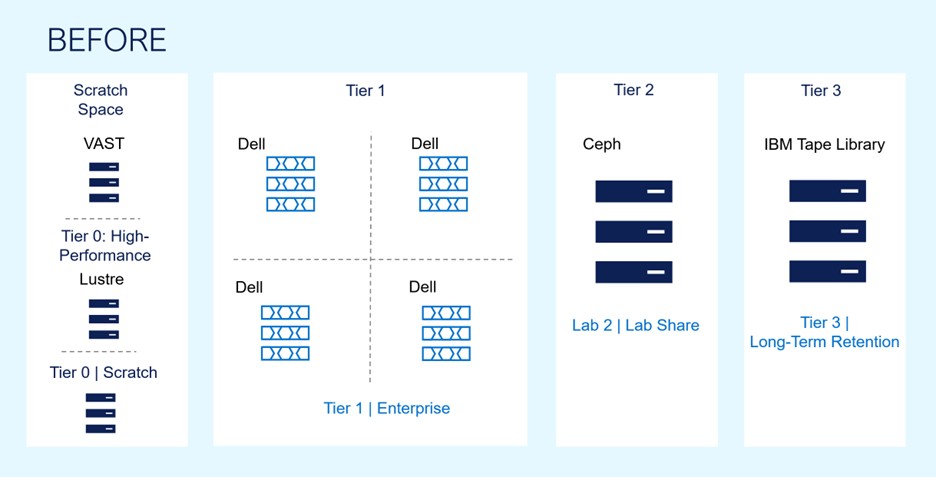
The institute was managing over 100 PB of data across diverse projects. Over time, growth across these projects led to six separate storage tiers, layered technologies, and a mix of systems that made workflows harder to manage. The result was inconsistent performance, rising costs, and a charge-back model that did not accurately reflect the true cost of the storage services.
The rapid growth of data and workloads outpaced the existing environment, making it difficult for researchers and IT teams to deliver at full speed. They needed more than another upgrade; they needed transformation.
The Challenge: Complexity That Stalled Research
-
- Fragmented infrastructure created silos and increased operational overhead.
- Unpredictable performance constrained HPC, AI, and ML workloads.
- Inefficient cost models led to overprovisioning and budget overruns.
The solution: From fragmentation to integration
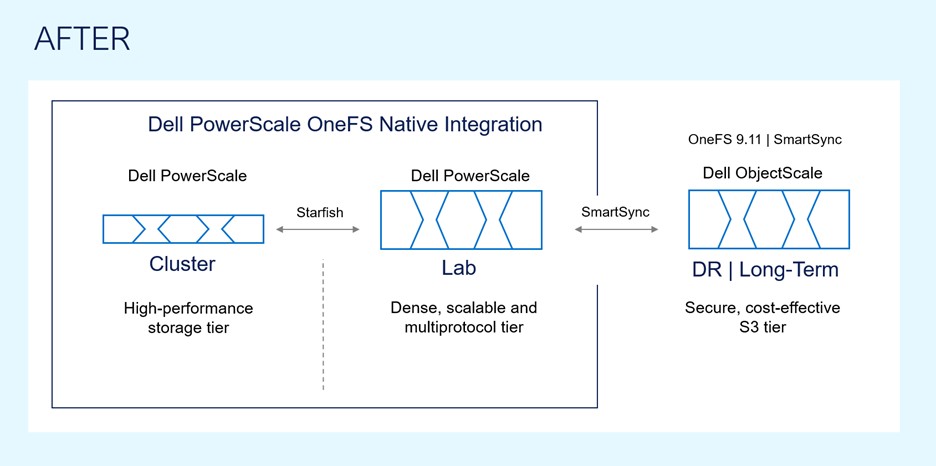
Dell Technologies worked with the research institute to design a simpler, more powerful architecture built on Dell PowerScale and ObjectScale. The solution consolidated six legacy tiers across five different vendors into one integrated Dell solution, eliminating multi-vendor complexity and hardware sprawl.
The Dell solution beat out competing vendors and delivered a unified model to:
-
- Balance high performance and scale to meet data center needs efficiently.
- Provide consistency under load for demanding HPC production environments.
- Manage long-term data retention with secure, durable storage for disaster recovery and archives.
- Eliminate financial risk with a flexible, predictable cost per TB per year for researchers.
Proof in action: Validated in the real world
The institute ran PowerScale against its incumbent systems and other vendors, including VAST Data. The results validated the Dell approach, showing that the design simplified operations and delivered measurable advantages in efficiency, performance density, and scalability over alternatives.
- Performance Where It Counts: Per Rack Efficiency
The institute found that PowerScale delivered the performance they needed with a smaller physical footprint. With 1/3 of the rack space compared to VAST, the results confirmed that performance density—not hardware sprawl— is what drives real efficiency and scale.¹
Measuring performance on a like-for-like, per rack unit basis, the institute observed that PowerScale delivered nearly 4x greater sequential read throughput and over 2x higher sequential write throughput compared to VAST.¹
By delivering consistent low latency and high throughput with RDMA over InfiniBand, the Dell solution reinforced that true differentiation lies in usable performance delivered efficiently, not in peak specs tied to oversized deployments.
(Read Next: Do More with Less: PowerScale’s Efficiency Advantage in NVIDIA Benchmarks)
- Consistency Under Live Workloads
Across industries, customers value infrastructure that performs predictably—even when workloads are under load. The results showed that PowerScale maintained more consistent performance with less impact on installs than competing solutions. During package deployments (Mamba, Conda, Spack), the institute observed fast and reliable completions on PowerScale, resulting in shorter wait times and uninterrupted research progress.
- Predictability Without Complexity
And finally, through Dell APEX, the institution gained budget transparency and elasticity. Departments could pay only for what they used – eliminating financial risk, avoiding overprovisioning, and aligning costs with actual research activity. This predictability also enabled them to establish a fair charge-back system that accurately reflected the cost of providing storage services to researchers.
Equally important, the institute appreciated the value of reducing multivendor complexity. Supported by Dell’s dedicated solution engineers and single-vendor architecture, they avoided the risk of support gaps and finger-pointing that often arise in mixed environments. For the institute, this meant confidence in both scalability and long-term partnership as their research and AI initiatives continue to grow.
Empowering the next wave of innovation
Dell PowerScale revolutionizes data management at scale, delivering efficiency and seamless production deployments. By combining PowerScale with ObjectScale, research institutes gain a scalable, efficient data foundation to support every phase of their AI and HPC workloads. This streamlined infrastructure empowers researchers to focus on what truly matters: driving the next breakthroughs that shape our world.
For more on Dell’s vision for AI-ready infrastructure, explore “Dell: Leading the Future of AI Data Platforms.”
1Based on third-party testing of Dell PowerScale. Results reflect sequential read and write performance per rack unit. Note that actual results may vary. Feb 2026.
