
Events
Building for an Accelerated Future: AI, Infrastructure and Governance
Practical steps to scale AI with secure data and governance - hear how Dell helps leaders move from pilots to production.
Key takeaways:
-
- Scale AI with secure, flexible infrastructure, strong governance and mission-aligned use cases.
- Address data readiness and workforce skills early to accelerate AI adoption in government.
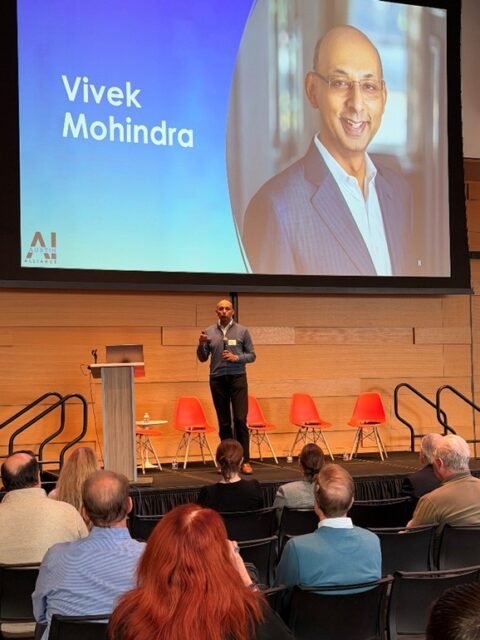
Recently, I delivered the keynote at two important gatherings: the annual State of AI in Austin and the US-India Chamber of Commerce AI Impact Summit 2026. The events brought together leaders, innovators and public sector stakeholders to discuss the evolution of artificial intelligence, the economic opportunity it is creating and the practical path from pilots to production. Here are some of the recommendations and observations I shared:
AI Is Accelerating Across the Stack
From infrastructure to compute to reasoning models, momentum is rising quickly. Data centers are scaling toward gigawatt levels, model capabilities are advancing at speed,—and agentic systems are quickly emerging. To stay ahead, organizations need to design for scale from the start and plan for continuous change. At Dell Technologies, we’re helping customers build an AI-ready foundation with AI solutions and infrastructure that align to mission, security needs and budget.
The Economic Opportunity
AI’s potential to transform the global economy is significant. By the end of the decade, AI could contribute up to $15 trillion to global GDP. For context, McKinsey estimates that generative AI alone could add $2.6 to $4.4 trillion in value annually across use cases. For public sector leaders, the opportunity centers on measurable mission outcomes such as faster citizen services, improved threat detection and more efficient operations.
Overcoming barriers to adoption
Despite the momentum, three barriers consistently slow progress for enterprises and government agencies:
-
- Unclear use cases: Organizations often struggle to identify where to begin, leading to scattered efforts and unclear outcomes.
- Solution: Focus on clearly defined, mission-aligned use cases that deliver measurable results while supporting organizational priorities and advancing the company’s broader business strategy.
- Data challenges: Insufficient data governance and insufficient access controls can produce inaccurate data, harming trust in the reliability of AI systems.
- Solution: Establish high-quality, governed data pipelines, create comprehensive data catalogs and implement robust access controls to ensure compliance and trust.
- Workforce skills gap: A shortage of expertise in AI, cybersecurity and data engineering limits the ability to scale AI initiatives effectively.
- Solution: Invest in role-based training programs to upskill teams, focusing on critical areas like AI development, data management and cybersecurity.
- Unclear use cases: Organizations often struggle to identify where to begin, leading to scattered efforts and unclear outcomes.
Make responsible AI the default
Responsible AI must be built in, not bolted on. Programs should be grounded in security, transparency, ethics and efficiency. Frameworks like the NIST AI Risk Management Framework provide practical guidance for governance, while CISA’s Zero Trust Maturity Model offers a roadmap to protect data, systems and models. These frameworks help reduce risk, improve auditability and streamline paths to ATO.
Driving progress for all use cases
We’re helping organizations move beyond experimentation to achieve real mission impact. As “customer zero,” we use what we build. Our internal journey informs how we guide customers through the same barriers they face. Through the Dell AI Factory approach and services, we help teams:
-
- Identify the right use cases tied to mission goals before setting technology requirements.
-
- Build secure, accessible data pipelines that support governance, privacy and policy.
-
- Design architectures that support Zero Trust principles, risk management and responsible data use.
-
- Modernize infrastructure for training, fine-tuning and inference across cloud and on-premises environments.
Our role goes beyond technology integration. We partner with government and industry to expand AI capacity through best practices and collaboration across security, modernization and data sovereignty. Whether operating in the cloud or on premises, we provide flexible infrastructure, program governance and practical strategies to harness AI for all use cases.
What government leaders can do today
Government organizations face unique challenges in adopting AI, from navigating complex regulations to addressing mission-critical needs. These complexities require thoughtful, strategic action to ensure AI delivers meaningful outcomes. By focusing on near-term steps that build momentum over time, leaders can accelerate AI adoption and drive impactful results:
-
- Start with the mission: Choose two or three use cases tied to clear outcomes, such as faster citizen services or enhanced threat detection.
- Prepare the data: Establish data catalogs, quality pipelines and access controls aligned with policy requirements.
-
- Build for security and scale: Apply Zero Trust principles, carry out model monitoring and modernize infrastructure for both training and inference.
-
- Upskill the workforce: Invest in role-based training for product owners, data engineers and cybersecurity teams.
In addition to these steps, government leaders have a critical role in shaping the regulatory environment for AI. By ensuring an agile framework that can keep pace with rapid technological change, governments can balance innovation with responsibility. This includes providing a consistent local, state, national and international framework that offers companies the clarity they need to compete in the global marketplace. By taking these steps, you can lay the foundation for AI adoption that not only addresses today’s priorities but also positions companies for long-term success.
Working together to shape AI’s future
It’s always great to connect with government leaders, technologists and policymakers committed to leveraging AI for the public good. These conversations highlighted shared challenges across sectors and opportunities for collaboration.
These events reflect a broader movement too—cities around the world are bringing together cross-sector leaders to focus on practical adoption and measurable outcomes. The speed of AI progress presents many opportunities. By working together across public and private sectors, we can guide this technology toward a secure, inclusive future that improves services for everyone.