
Dell Pro Max
Advancing Behavioral Health Research with Fake Data
There are limits to patient data the Child Mind Institute can share, so they're building synthetic copies of children's records.
Key takeaways: Dr. Gregory Kiar at the Child Mind Institute faces a fundamental tension in behavioral health research. Unlike lab results for physical ailments, behavioral data is inherently identifiable, making traditional anonymization destructive to clinical signal. His team is developing a pipeline that selectively anonymizes real pediatric psychiatric records, extracts features via fine-tuned language models and generates synthetic data using GANs and LLMs that run locally on Dell Pro Max with GB10 workstations. The result is a statistically faithful, sharable dataset of childhood psychiatric presentations that protects every real patient while preserving the diagnostic complexity other researchers need.
This is the third entry in a six-part series exploring how researchers are diagnosing and sharing brain health data in youth in a manner that protects patients and is ethically responsible. The first entry laid out the hurdles of diagnosing and treating children with brain health conditions; the second article shows how brain health data can be protected through anonymization pipelines. This entry explains why anonymizing brain health data alone isn’t sufficient.
Dr. Gregory Kiar, Director of the Center for Data Analytics, Innovation and Rigor (DAIR) at the Child Mind Institute, has some of the most detailed records of childhood psychiatric conditions anywhere, but he can’t share all of it. “The signal is behavior,” he says. “If people can see it then they can associate it with a specific patient.”
That distinction separates behavioral health from fields like oncology. In cancer research, the signal lives in a lab result that travels safely between institutions once you strip the name and other identifiers. In behavioral health, the signal is observable. Redacting a name doesn’t separate the data from the person who produced it.
The anonymization problem
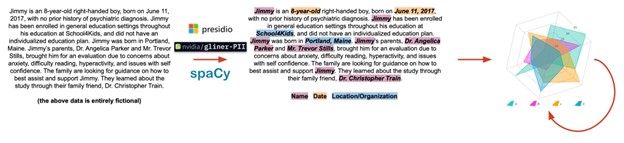
The novice instinct may be to aggressively anonymize patient data. Strip out names, locations, school names, specific behaviors and anything linking a record to a specific child. Kiar’s team does this, but with deliberate restraint. “Extreme anonymization, where we’re removing any possible trait of identifiability, means also removing all signals, which means the data becomes effectively useless to model,” Kiar explains.
Consider a clinical note mentioning anxiety, difficulty reading, hyperactivity and low self-confidence. A clinician doesn’t see four separate problems. They might see a learning disorder with anxiety and self-confidence as downstream effects. Strip enough context to fully anonymize that note and the interpretive layer collapses.
Kiar’s team removes what they call the noise of identity including proper nouns, geographic markers and other markers that may allow a model to train on, say, location rather than symptom. They preserve clinical texture, diagnostic density and cross-symptom relationships.
Building a synthetic child
After targeted anonymization, Kiar’s team feeds records through fine-tuned language models, including transformer architectures like BERT trained on medical literature, to extract features from text at scale. They compare text embeddings against clinical definitions, such as the ICD-11 and DSM-5, to assess how closely any given note aligns with specific diagnostic criteria. The result is a spreadsheet of derived columns representing every measurable signal the models can surface.
From there, the team maps which symptoms co-occur, where diagnostic patterns cluster and identifies presentations that tend to appear in population segments. Then they generate synthetic records using a mix of generative adversarial networks and large language models, intentionally drawing from multiple architectures so that no single model’s structural biases shape the output.
“The new hypothetical simulated child has no tie to any existing human,” Kiar says. “They are a simulated data point that represents a realistic spread of symptoms and characteristics.”
One counterintuitive choice stands out. In most data science contexts, unusual data points get filtered as noise. In brain health, labels are inherently subjective. What looks like a statistical outlier may be a genuinely rare but clinically real presentation, or simply one from a group under-represented in the broader dataset. Discarding outliers makes a model less accurate for the patients who need to be seen the most.
Computing on the ground
Clinical data at the Child Mind Institute must be handled safely and cannot leave the building or private cloud environments. To remain compliant in a highly regulated field, Kiar’s team utilizes Dell Pro Max with GB10 workstations. The AI workstations provide Kiar’s team the compute to run larger models on-site with low latency. Before the GB10 arrived, the team was constrained to either large bills when running in private cloud environments, or smaller models and shallower feature sets. The GB10’s 128GB of unified memory allows for complex embeddings, finer-grained feature extraction and a more faithful statistical picture of the underlying population, while operating completely on-premise.

Quality evaluation
Quality evaluation is large enough that Kiar is saving the topic for our next conversation in this series. The short version involves three axes: level of variation from the real data that is preserved, how identifiable any synthetic sample may be and how fairly the data represents subpopulations. Girls with autism, for example, are often overlooked relative to boys with autism. If the generative model doesn’t account for these sorts of biases, then the synthetic dataset perpetuates the same underrepresentation.
When the Child Mind Institute’s data passes quality evaluation, it becomes a sharable, statistically faithful record of childhood psychiatric presentations and a quality dataset that other researchers can use.
This is the third post in a six-part series on advancing brain health research through secure data practices. Prior articles explored overcoming the eight-year treatment gap in childhood brain health and synthetic data generation. Follow Dr. Gregory Kiar and Logan Lawler to be notified when the next article is released.